
A common question we get asked is how to meet a crane manufacturer’s requirements for a level crane. OSHA and ASME both state that a crane must be level to within 1-percent grade. But, what does this mean and how do you accomplish this?
Before we get too far, let’s consider what a 1-percent grade looks like. Consider a distance of 100-inches, and along this distance the ground had a difference in elevation of 1-inch. That is 1-percent. How many jobsites have you seen that are this level? Chances are some work is going to be required to meet this requirement.
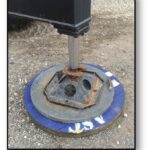 What about a crane that uses outriggers to level the crane? How level must the ground be where the outrigger floats are positioned? Applying the 1-percent rule requires, for example, a 24-inch diameter outrigger float to be level to within ¼-inch. The main point is the outrigger floats must be perpendicular to the outrigger jacks and the floats must also be level within 1-percent.
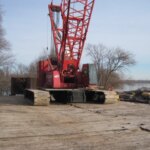 The 1-percent rule applies to crawler cranes too. It’s not uncommon that earth moving equipment must level the area where a crawler crane will be working and any mats must be properly supported and level.
Now, why would it be important to maintain a crane with a 1-percent grade? There are a few reasons but one of the most important is that any out of level condition puts a side load on the crane boom. And, of all the things one can do to a crane, side loading of the boom is one of the most dangerous. And, when it comes right down to it… every crane manufacturer tells you in their notes that all crane ratings are based on the crane being level to within 1-percent of level grade. In other words, the amount of load any crane can safely lift and handle is completely unknown if the crane is not level to this tolerance.
So, let’s talk about the level that’s used to level your crane. Bulls Eye and inexpensive carpenter type levels are typically not very reliable. If you have ever noticed a large bubble on a hot day then find the bubble to be very small on a cold day the quality of your level is sub-standard. A spirit level, also known as a whiskey stick, uses alcohol such as ethanol rather than water. Alcohols have low viscosity and surface tension which allows the bubble to settle quickly and accurately; they also have a greater liquid temperature range which stabilizes the size of the bubble.  When you are ready to refine your crane’s levelness put a spirit level on the turntable or under the boom foot pins in an area that’s not influenced by distortions in the carrier deck. Check your crane’s level in different rotational areas to be certain the crane is level in all directions. Keep your level handy though, because you will need to recheck level frequently because a working crane will settle and change the original level setting.
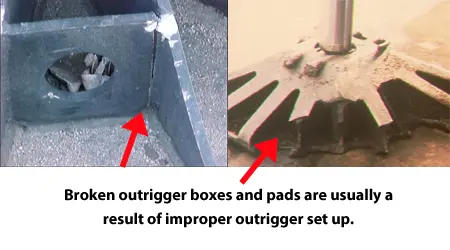
Over the 39 years that Crane Tech has been performing training and crane inspections we have seen many seriously damaged outrigger floats due to the float being positioned off-plane with the outrigger jack. We also know that a majority of crane accidents are the result of improper crane set up. You only need to see one outrigger float collar that’s broken as a result of a jack side loading to understand just how serious this is. Don’t take the risk of broken equipment or an accident. Be a 1-percenter and keep your lifts, personnel and equipment safe.
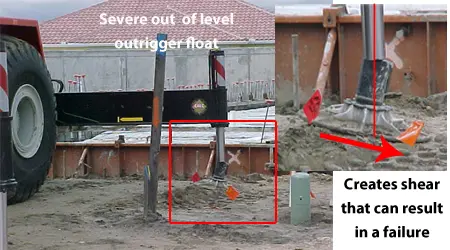
For more information about outrigger set up, check out our Hooked On Crane Tech Blog Post on Avoiding Outrigger Failure because Safety through Education is more than our motto it is our guiding principle.