
It’s no doubt that the best start to a safe productive day is with a qualified operator and a complete pre-operational inspection of your crane, as we discussed in the First Line of Defense post. However we want to submit another layer of checks for you to consider. It’s not enough just to go through a check list to make sure each piece of equipment is not just turned on and working. Today mobile cranes have state-of-the-art Load Moment Indicators (LMI) that require a method to ensure the accuracy of their measurements and readouts.
 Comparing known values against the readings is an easy way to ensure all indicators and readouts are accurate while providing that extra peace of mind. How do you know that the 45’ radius, the 30-degree angle, and the 1,500 lbs. load weight reported on the LMI is correct if you don’t verify your equipment?
Here is a simple check that will allow you to easily verify the LMI every day or if ever there is a question of an LMI’s accuracy. The first time this exercise is set up it will take a few extra steps, after the initial readings are recorded, each day it will go much quicker.
 One Time Set-Up
The first step is to create a point of reference and determine its radius with a physical horizontal measurement. On hydraulic mobile cranes with outrigger systems, extend the outriggers and level the machine as you would to start work. Take a given outrigger and measure the radius to the top of the outrigger jack/cylinder and make that radius the point for reference. When working with longer, fixed-boom cranes it will take a little effort to stake out a proper frame of reference, but once they are set up, the reference point can be used as long as the crane remains in position. Pedestal mounted cranes and boom truck cranes are the easiest to set up given their stationary position with reference to a large deck or bed. Simply measuring out a given radius or two and permanently marking the deck (or truck bed) gives a point for reference. This practice can be extended to tower cranes as well.
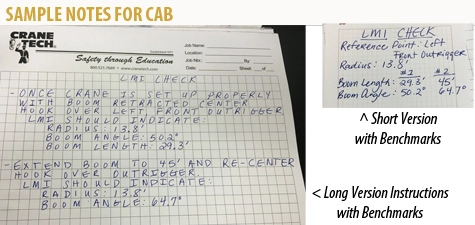
Once the point of reference is created and measured, the next step is to record the LMI data at several boom lengths and boom angles. First, with the boom fully retracted place the crane hook over your point of reference and record the boom angle and boom length from the LMI readout. These become the benchmarks for your LMI with your boom fully retracted. Then extend the boom to any amount of boom length (in this example we will extend to 45′). Then boom up to re-center the hook on the point of reference and record the boom angle from the LMI readout. Now you have a benchmark with the boom extended to 45′. We recommend that these measurements be verified against the load chart range diagram to make sure they are accurate. If they are accurate, then write them down (examples below) and keep inside the crane cab for the next time you check the accuracy of your LMI readout. If they are not accurate, then record this as a major deficiency in your crane inspection log book and report it to your superiors for repair.
Daily Check
Now with the benchmarks in place, the LMI can be easily verified during the pre-operational check, or whenever there is a concern that the LMI is not working properly. Place the hook over the reference point with the boom fully retracted. Check the boom angle against the written bench mark, if it is good then extend the boom to the next noted length and check the boom angle. If the boom angle readouts match the recorded benchmarks, then you are good to go, knowing your computer and your crane are in sync. If there is a deviation from the usual benchmarks, then a further inspection would be required.
For more in depth training on Mobile Crane Operations, check out our Open Enrollment Courses or the On-Site Program option. Also, don’t forget to keep checking the Hooked On Crane Tech Blog for more insight on what to do if your LMI is not working properly – a future post is in the works.