
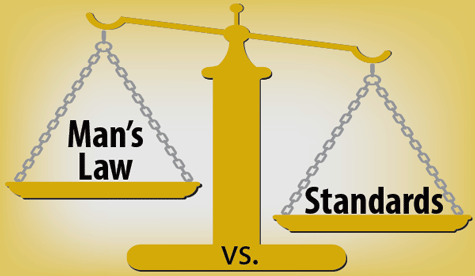
Have you ever heard of a ‘Man’s Law’, as it pertains to something in the industry? It could also be better known as a ‘rule of thumb’ or advice/instruction given which has no legal backing; however it was delivered in a manner that made it seem like it does.
For example, one of our clients was recently told by one of our competitors that “ALL chain slings must be replaced every 5 years.” Well, that is not the case, but the person who received the information surely didn’t know and they were ready to take it at face value. Can you imagine what that would do to an annual rigging budget?
We’ve also heard, “Synthetic slings can only be used for 1 year.” This is not true either. While the Crane Tech instructor who heard this thinks it was just a plan to get out of doing an annual inspection, it could cost a small fortune to replace slings that still had plenty of life in them.
Instead of taking these ‘Man’s Laws’ at face value, we always encourage management and operators/riggers to check the standards for themselves. We also encourage you to ask where such statements are referenced. In the case of slings, age is not a factor for the removal of slings. Instead, slings should undergo inspection according to industry OSHA and/or ASME B30.9 standards. But at a minimum the following inspections should be completed to determine when a sling is fit for service:
- Initial inspection – prior to first use to document initial length and other measurements, etc.
- Frequent/pre-use inspection – by the qualified rigger before it is used. If there are any reasons for concern it should be taken out of service and marked for review by a qualified person
- Periodic inspection – by the qualified person who compares the current measurements against the initial inspection records and also looks for other damages or concerns according to the standards to determine if the sling is safe for continued use or needs to be destroyed
Another ‘Man’s Law’ we’ve heard, “Every time you change the wire rope on a crane you have to load test it.” Again, one must go back to the applicable standard. In this case, ASME B30.5-2.2.2(b)(1) specifically states that “The replacement of the rope is specifically excluded from this requirement.” A functional test under normal operating load should be made prior to putting the crane back in service, when the wire rope has been replaced.
One of the most common ‘Man’s Laws’ that we continually hear is, “Outrigger pads (cribbing) must be 3 times the size of the outrigger float.” While this sounds good, it might not keep your lift safe. Instead, OSHA 1926.1402(b) states, “that cranes must be assembled on ground that is firm, drained and graded sufficiently, in conjunction with supporting materials, such as blocking, cribbing, pads, or mats, to provide adequate support and levelness.” So you need to determine what ‘adequate support’ looks like for your job site. The only reliable way to do this is to calculate it. For more on this subject, check out this Hooked On Crane Tech post, Rule of Thumb for Outrigger Support.
Do you have a ‘Man’s Law’ to share for material handling? We’d love to hear it and the applicable standard that sets the record straight, comment below or email us.
Remember, Safety through Education is more than just our motto, it is our guiding principle. If you have questions as they relate to the safety of your site or operations or need training for your employees, call 800-290-0007 or request a quote. You never know, your question just may end up the topic for a future post.
P.S. Keep in mind, depending on the industry and/or company policies/procedures, there may be other applicable standards or rules that govern a work site. In this case, the policies should meet, if not exceed, the nationally recognized industry standards, but don’t mistake them to be a ‘Man’s Law’ to enforce when outside of these special circumstances.