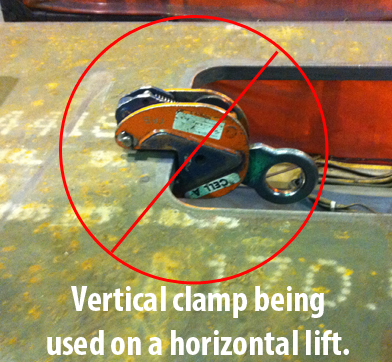
Plate clamps (or friction-type pressure gripping lifters, according to ASME B30.20) are a lifting aid that grip the load. They are a necessity in the lifting operations for many industries, but when a lift goes wrong, there is an opportunity for education. In this case a worker lifted a 5/8″, 460-pound, plate of steel from a horizontal position and rotated the plate to vertical with a plate clamp. While attempting to attach a tag line to the clamp the plate slipped and landed on the worker’s foot breaking three bones. An accident investigation identified the following:
- The plate clamp being used was designated for 1-1/4″ to 2″ plate and was rated for 6,000 pounds.
- The plate clamp used to lift and rotate the plate was clearly marked for vertical lifting only.
- The weight of the plate was too light for the plate clamp size that was used.
- The employee was not properly trained in the use of plate clamps.
While we are thankful that the injury was not more serious, could it have been avoided? Absolutely! So let’s look at 15 Tips to help maintain safety when using plate clamps.
15 Helpful Tips for Safe Plate Clamp Use
- Prior to lifting using a plate clamp, the user should determine if there is a safer way to accomplish the work. If it is deemed this is the safest and acceptable method, then before lifting review the specification sheet that’s supplied with the purchase of every plate clamp.
- It’s a good idea to laminate the specification sheets so they can withstand the elements in the field, and keep them where they will be readily available to users for review prior to plate clamp use.
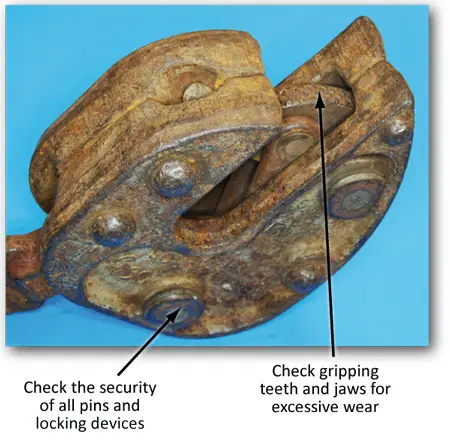
- Inspect plate clamps before each use. The user needs to understand the manufacturer’s specifications on teeth, jaw, pin, and assembly wear and rejection criteria. This information is manufacturer specific, so the user needs to be knowledgeable of each manufacturer’s specs. If a plate clamp appears excessively worn, mark it and remove it from the work area.
- There are three types of plate clamps designed for overhead lifting. Be sure to use the correct clamp for the job task:
- vertical lift only,
- horizontal — to and from vertical through a 90-degree plane, and
- horizontal — to and from vertical through a 180-degree plane.
- Plate clamps are not designed to lift plates which exceed 300 Brinell hardness.
- Plate clamps are designed to lift the thickness of plate identified by the manufacturer’s identification plate located on the clamp. They must never be used to lift plates less than or greater than the thickness identified on the plate clamp identification tag.
- Plate clamps must only lift one plate at a time. (The exception to this rule is lifting a stack of plates horizontally with two or four clamps approved for this type of lifting.)
- Plate clamps must never be overloaded. Always calculate the plate weight and size your clamp appropriately.
- Plate clamps are vulnerable to “under-loading” when they lift less than 50% of the WLL of the clamp. An “under-loaded” plate clamp can allow a load to slip free.
- Always center the plate clamp directly above the plate’s center of gravity. A plate that hangs out of level puts undue side stress on jaw teeth allowing load slippage.
- If a tag line is to be used to control the load it must be fastened to the plate clamp prior to lifting.
- Keep loads low to the ground and stay out of the “fall-area.” Remember that a steel plate may fall on its edge but then falls over to one side. Never place your body in the “fall-zone.”
- Be especially careful when lifting steel plate to any elevated area. The plate will act like a sail and the wind load can cause the plate to swing out of control resulting in loss of the load. In these cases the “fall-zone” must be expanded.
- Specific plate clamps are designed to lift finished and polished plates with non-marring smooth gripping surfaces. These should be used in pairs supported by slings and a spreader beam.
- Just like any other lift, avoid shock-loading when using plate clamps.
Refer to this post as often as needed and remember that Safety through Education is more than just Crane Tech’s motto, it is our guiding principle. Want to know more about a specific below-the-hook lifting device? Comment below.