Today is National Fork Lift Safety Day, sponsored by the U.S. Industrial Truck Association, however we know that in reality everyday requires an emphasis on safety. It is a constant battle that requires keen awareness and focused attention to keep operators, workers, equipment and the public safe.
Forklifts, or powered industrial trucks (PIT), are probably the most commonly used equipment to move materials. There are many types, used across numerous industries, and used in various work environments. They are made to be versatile, operate on a variety of surfaces and in a wide range of conditions, but many precautions need to be considered when operating.
As we focus on forklift safety lets talk about some basics regarding awareness of the forklift’s environment with some helpful pointers to help maintain safe operations.
Surfaces and Floor Limits
 Are there slippery conditions, uneven surfaces or ramps? First and foremost, try to keep it simple and avoid any hazardous surface. If you must cross a slippery surface, do so slowly and with caution. If you must cross uneven surfaces, speedbumps, or railroad tracks cross diagonally and slowly. If you must travel on a slope or ramp, travel with the load upgrade. If you are traveling on a slope or ramp without a load, travel with the forks downgrade.
What is the floor loading limit? Are you operating on a solid surface? Remember if you are entering a railroad box car, a truck trailer, an elevator, or working in a multi-story building you need to inspect its floor and check its load limits. Even very small forklifts are much heavier than you might realize and they can cause the floor to collapse. Make sure the floor you operate on has been approved for the weight of the loaded forklift.
Loading Docks
Are you working near loading docks? Many loading docks do not have any provision to prevent a forklift from driving off the end of the dock when a truck is not present. These areas must be avoided when this hazard exists and a good method is to place a chain or barrier across the loading dock openings when they are not in use. When using a dock to load a truck you must make sure the truck/trailer cannot inadvertently move away from the dock.
Overhead Clearance
What are your overhead clearances? Look around. Potential hazards include: low ceilings, stacks, pipes, sprinklers, overhead crane blocks, and pendant stations. Be aware of the height of light fixtures and door openings.
If outside, where are power lines? Always be aware of the power line locations and maintain a proper power line clearance for your industry. We know of more than one fire that occurred when a forklift/load came in contact with a power line.
Handling Loads
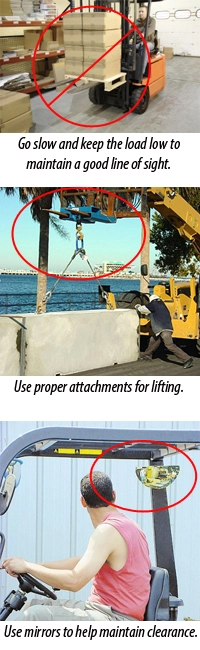 What are you lifting and will it obstruct your view? If your load obstructs your view, travel in reverse and reduce your speed or use a spotter to direct your travel. When traveling with a load, lift it only enough to clear the ground. The center of gravity of the forklift shifts as a load is raised and this can cause a tip over. If a different type of lifting device is necessary, such as a hook or carpet pole, use only manufacturer approved attachments for that particular forklift. Do not fashion a shop-made device or rig from the forks.
Blind Corners and Intersections
Will you be traveling through blind corners or intersections? Always approach corners and intersections slowly. Remember, your forklift will enter a blind area before your vision can see any hazards. Make sure parabolic mirrors are placed and maintained so pedestrians can see you coming and you can see them. Sound your horn to warn persons of your entrance to one of these areas.
Pedestrian Traffic
Are there people working in the area? Unfortunately, many accidents happen when individuals are struck by the forklift or a load falls on them. Follow company procedures, use caution, go slow and make sure they are aware of your presence. Wait for them to clear the area or ask the person to stop and wait.
For more on forklift operator training consider attending Crane Tech’s Forklift Operator Train-the-Trainer course. Our program teaches participants to train and test forklift operators and to meet the OSHA and ANSI training and operator qualification requirements.
For more information on forklifts in the United States try visiting osha.gov, and also check out OSHA’s Powered Industrial Truck (forklift) etool. For the regulations that govern powered industrial trucks (forklifts) check out OSHA 1910.178.