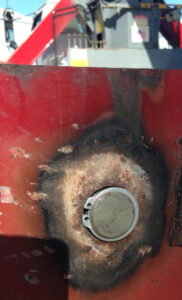
 Recently we were at a client’s location, demonstrating how to perform a pre-use inspection and noticed an outrigger box and pin had received repairs. The instructor asked the class if “anyone knew what had happened?” Several of the students were part of the maintenance crew that had been involved, spoke up.
The Back Story
Some repair work needed to be done on the hydraulic cylinder of the outrigger which required that particular pin to be removed. When trying to remove the pin, it was stuck. So the crew decided to use heat with a blow torch to loosen it, remove it and make the repair to the cylinder. A new pin and snap ring were installed and they were good to go. End of story, right? Wrong.
When heat is applied to structural, load-bearing components, it can compromise the structural integrity of the steel. The outrigger box and pin on an “A- frame” style outrigger is a structural load bearing component. So, there is no way of knowing if this repair caused any damage. The question is, would you want to perform a lift knowing that your outrigger could structurally fail at any given moment? When in doubt, contact the manufacturer.
The Rest of the Story
With our client’s permission, the Crane Tech instructor reached out to the manufacturer and sent pictures. The manufacturer conferred with their engineers and let our client know that they needed to replace the whole outrigger box—a repair that will cost substantially more.
So what are our suggestions to keep this from happening?
- Always follow the manufacturer’s instructions for repair.
- When in doubt, stop and ask the manufacturer – when the pin was found to be stuck, it would have been wise to reach out to the manufacturer for their recommendation on how to resolve the problem. They usually have a written standard operating procedure (SOP) for repairs.
- Don’t take a blow torch or other heating device to a structural component of your crane – its never a good idea.
- Contact a reputable service technician to have a qualified crane mechanic repair and replace parts if it is over and above the knowledge of the maintenance crew. These professionals will have access to appropriate tools (such as oxygen/thermal lances or pin pullers) and the knowledge to accomplish the task.
- Use OEM equipment or parts recommended by the manufacturer. If repair parts are not available or discontinued make sure the substitute has at least the same design factor.
Remember, Safety through Education is more than just our motto it’s our guiding principle. If you need training on safe operation, inspection or guidance on a particular situation we are here for you. Comment below, call or email us today.