
A Q&A on Tag Lines – Part 3
 Over the last two posts, we discussed the need for tag lines and their proper application, as well as what the handler needs to know before holding a tag line. This week we are moving to some more practical application questions and items that may not be discussed as often with tips to make your lifting operations safer. So let’s jump right in:
What should tag lines be made of?
According to OSHA §1926.1410(d)(7) when working in proximity to power lines, “If a tag line is used, it must be of the non-conductive type.” It is for this reason that best practice is to have all tag lines made out of non-conductive material. While it is ok to have tag lines made out of natural fibers or synthetic ropes, these they can easily become conductive if they become wet or dirty. So it is imperative to keep these tools clean and dry.
Crane Tech recommends braided polypropylene for its resistance to moisture and electrical current. This type of rope is easy to use, very efficient, reliable with most knots, and easy to untie.
Tip: Do not use electrical extension cords, wire, air hoses, wet rope or fall protection lanyards as tag lines.
How long should a tag line be?
There is no specified length for a tag line. It should be an appropriate length to assist with load control throughout the whole lift (when possible) while keeping the handler out of the fall zone. While there are various rules of thumb on this, but it is best to stop and calculate the length that will be needed based on the height that the load will be lifted. For every foot off the load is off the ground, the tag line handler will need to be double to three times that distance away from the load to clear the fall zone. For instance for an object 10 feet of the ground the tag line handler would need to be at minimum 20 feet away. Increase this distance as necessary to ensure the handler is out of the fall zone.
Tip: Have tag lines of various lengths available on the site.
What should be done with any extra length?
The calculation has been completed and it was determined that you will need 30 feet of tag line to complete the lift, but for the first portion of the lift you will only need 10 feet. What do you do with the rest? Let it drag on the ground? Pile it up on the ground? Hold it in the opposing hand? We’ve seen it all. But 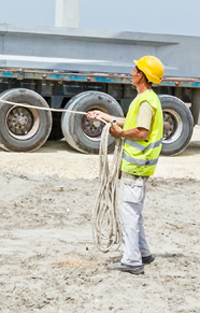 for the safest method, we recommend that the excess be loosely held in the hand opposite of the tag line and neatly coiled in a manner that will allow the rope to lengthen as necessary. This method reduces tripping hazards, helps maintain the condition of the rope from dragging on the ground and picking up debris, and lowers the potential of having the excess tag line snag on objects.
Tip: Treat the extra tag line length as you would a buoy/life preserver, loosely holding the coiled tag line in the opposing hand so that it can easily lengthen without tangling.
How to retrieve a tag line?
When a load is being lowered with tag lines hanging and the handlers will have to retrieve the tag lines, it is imperative that this be a well thought out part of the lift plan. Handlers should not put themselves under the load to retrieve the tag line, so get creative and think through this before the lift. Discuss not only how to retrieve the tag line as safely as possible, but that the operator must be given “stop” and “dog everything” signals prior to the handlers retrieving the tag lines.
Tip: When the load has been lowered enough to safely gain hold of the tag line, the safest way to do this is to use a boat hook or a push/pull pole with a hook designed for this purpose.
What are other alternatives to tag lines?
Tag lines were created to keep personnel out of harm’s way, however they are not the end all be all for load control, especially when they create a bigger hazard than they solve. It is imperative to discuss other alternatives for load control/positioning prior to the lift. Other alternatives to tag lines include:
- Manual Load Control – controlling the load by keeping one hand at arm’s length on the load. This only acceptable when the load is at waist to shoulder height and not being moved in a fashion to cause a hazard.
- Push/Pull Poles – tool designed to help facilitate “hands-free” guiding. There are many versions of these. Some are adjustable, have hooks, rubber ends, etc. They allow the rigger or handler to remain at a safe distance from the load until it has landed.
Tip: Don’t be afraid to think outside the box, as long as the answer keeps employees, loads and the job site safe. Try different things for different applications, there may not be an end-all-be-all solution for tag lines and load control that work.
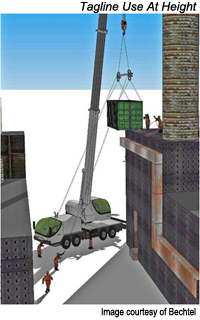 How do you handle tag lines for loads lifting to height? (a reader submitted question)
As a load is raised it may reach a height where the increasing vertical angle of the tag line may render the control ineffective. In this case, Monty Chilsom at Bechtel Equipment Operations, suggests that the load has a set of long tag lines for control from the ground to a certain point and a second shorter set that are initially slack and can be retrieved by the handler(s) by using a hook and the methods described above. Again this should be discussed as part of the lifting plan prior to the start of the lift.
If you have a question about a tag line that wasn’t covered in this series that you’d like to see answered, let us know by commenting or email us. Remember that Safety through Education is more than just our motto, it is our guiding principle.
At Crane Tech, we provide superior training and consulting services to ensure safety and create reliability within the material handling industry. Have a question regarding our services or if you’d like a quote, please reach out.