
 We recently received a question from a client who was looking for more information about “standing or working under suspended loads, especially while erecting and working with tower cranes.” Chances are we received this request due to a concern they had on their site. After all, it is common for construction sites to be busy places, with many trades and workers focused on their tasks at hand. However, all too often these individuals are not aware of the dangers of working near cranes and/or suspended loads, which could lead to serious injury or death. Note: for those who like example stories, we will include some links to a few applicable accident reports, but we are not going to go into any details in this post directly.
Now back to the topic at hand. While the inquiry seemed like a simple subject to write about, the more we thought about the request, it became clear that there were three different areas to expand upon:
- What to do when working around a crane that is handling loads
- What to do when working around a crane that is being assembled or disassembled
- What to do when working around a tower crane
Because the safety of crane operations is not something we want to gloss over this blog post will address the first component, and be followed next week by a discussion on the second and third components.
Working Around A Working Crane
First of all let it be said that standing and working under a suspended load is NOT ALLOWED under U.S. OSHA regulations, unless a specific set of criteria is met. If you are not in the United States, then what is permissible may be different, but no matter the site location, putting your body under a load or even the travel path is just a bad idea. However we can’t just look at the area directly beneath the load.
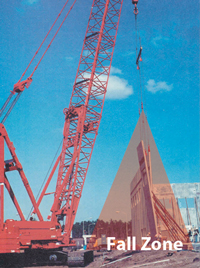 We have to expand it to the “fall zone” or the area in which it is foreseeable that a suspended load could fall in the event of an accident. In the image shown here the red shaded area represents the fall zone, which includes the space 360 degrees around the the panel, because if it were to fall it could end up flat on its side. No hard hat or steel toe is hard enough if a load were to fall, no safety vest is bright enough if you are in the wrong place or not in view of the operator, so the best way to minimize risk is to stay clear of the load and crane if you are not directly involved in the lifting operations.
While the OSHA 1926.1425 “Keeping Clear of the Load” regulations detail the requirements for lifting in the U.S., they provide good guidance no matter where you are lifting. A summary includes:
- Avoid carrying loads over people. Plan the load travel path to minimize exposure to individuals on the site.
- When a suspended load is not moving, it is only permissible to have an employee in the fall zone if they are:
- hooking, unhooking or guiding the load
- doing the initial attaching of the load to a component or structure; or
- operating a concrete bucket.
- The load must be rigged to prevent unintentional displacement. Accident: Employee Injured When Struck by Falling Crane Load
- Hooks with self-closing latches or their equivalent must be used. (“J” hooks are permitted to be used for setting wooden trusses.)
- The load must be rigged by a qualified rigger.
- When a load is being landed, only employees needed to receive a load are permitted to be within the fall zone. Accident: Employee is Struck and Killed by Crane Rigging
- During a tilt-up or tilt-down operation, no employee must be directly under the load and only employees essential to the operation are permitted in the fall zone if it is not feasible for the employee to perform that operation from outside the fall zone.
So what are some additional tips to help carry out these regulations and keep your site safe?
- Keep the work area clear of non-essential personnel — where feasible erect warning lines or barriers around the crane travel path.
- Make sure all lifting personnel are trained and qualified in their respective areas (operators will have to be certified by November 2017).
- Make sure trades and those working in the vicinity are informed about the risks of working around cranes and remind them to stay well clear of suspended loads, the crane boom and the load travel path. Accident: Employee’s Arm Fractured By Falling Headache Ball
- If you need to guide a suspended load, use tag lines, not your hand or body.
- Use ONE dedicated, qualified signal person who continually communicates to the operator using approved (hand or voice) signals.
- Never raise the load more than necessary. Keep it as low to the ground for as long as possible before raising the load above head level. When lowering a load, don’t allow the load to remain above head level longer than necessary (i.e. bring the load to ground level as soon as possible).
- Never leave the load suspended in the air.
- Use proper rigging hardware, slings and techniques to support and lift the load.
- Assure all slings, hoists, crane and machinery components are inspected before use and in adherence with your preventive maintenance and manufacturer’s requirements.
Remember, no one ever plans for an accident but you can plan for safety. Stay tuned next week as we discuss Part 2: Working Under the Hook?, regarding the assembly/disassembly of cranes and about working around tower cranes. In the meantime, if you have any questions related to the safety of your site, let us know! Safety through Education is not just our motto, it is our guiding principle.
P.S. Remember always consult your applicable regulations directly. In the U.S. printed copies of the OSHA 29 CFR 1926 Subpart CC – Cranes and Derricks in Construction standard and many other reference publications are available through our Products Catalog.