
 As we discussed in Part 1, standing and working under a suspended load is NOT ALLOWED under U.S. OSHA regulations, unless a certain set of conditions takes place (most of them related to hooking or unhooking the load). So now let’s look at the situation of while the crane is being assembled/erected/climbing or disassembled/dismantled. Going back to the sensible thing, of course one should stay out of the fall zone, but what does the standard say as it relates to how the crane is erected? Note: Similar to Part 1, we are going to include links to relevant accident investigations instead of sharing the details in this post. Also for brevity the terms related to assembly/disassembly will be used but could be interchanged with erecting/climbing/dismantling, etc.
The procedures and requirements for assembly/disassembly are clearly addressed in OSHA 1926.1403 to 1926.1406, 1926.1412 and 1926.1435 (for tower cranes only). One of the first criteria is that assembly/disassembly must be directed by an “A/D Director” a person who meets the criteria for both a competent person and a qualified person or a competent person who is assisted by one or more qualified persons. This person must understand ALL of the applicable assembly/disassembly procedures not just for OSHA but other standards as well.
Working Around A Crane During A/D
While we could get lengthy here, for the purposes of this post, we are going to summarize the regulations that dictate how to work near the crane or its components during assembly/disassembly:
- Before a crew member goes to a location that is out of view of the operator (either in, on, or under the equipment, or near the equipment/load where they could be injured by movement of the equipment/load) they must inform the operator that he/she is going to that location.
- Where the operator knows that a crew member went to a location that cannot be seen, the operator must not move any part of the equipment/load until the operator is informed in accordance with a pre-arranged system of communication that the crew member is in a safe position.
- When pins (or similar devices) are being removed from the boom, jib or other components, employees must not be under the boom, jib, or other components. Accident: Employee Is Injured While Disassembling Crane
- The exception is when site constraints don’t allow for enough space, the A/D director must implement procedures that minimize the risk of unintended dangerous movement and minimize the duration and extent of exposure under the boom. (i.e. create sufficient blocking so that the boom or jib rests on the blocking and will not be able to fall on the employee. See Appendix B – Sample Procedures for Minimizing the risk of Unintended Dangerous Boom Movement
- Employees should be positioned so that their exposure to unintended movement or collapse of part or all of the equipment is minimized.
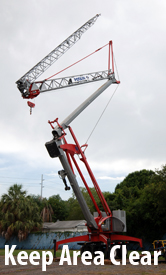 For self-erecting tower cranes, employees must not be in or under the tower, jib, or rotating portion of the crane during erecting, climbing and dismantling operations until the crane is secured in a locked position and the competent person in charge indicates it is safe to enter this area, unless the manufacturer’s instructions direct otherwise and only the necessary personnel are permitted in this area
So what are some additional tips to help carry out these regulations and keep your A/D operations safe as it relates to working under the load?
- Make sure to review the procedures with all personnel involved immediately prior to work commencing.
- Follow the manufacturer’s instructions for that specific crane. Many steps and cranes are similar but the order of steps may vary from one model to the next. Accident: Boom Section of Crane Separates and Crushes Employee
- Know the area and size of the fall zone and where feasible erect warning lines or barriers around the area.
- Keep non-essential personnel out of the area.
- Schedule assembly/disassembly during non-peak hours.
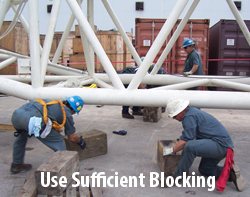
- Have sufficient and proper blocking on hand to support the structural integrity of the equipment and protect workers lives and extremities.
- If working at a height, use safety devices, such as tethers on tools or bolt bags to secure items at risk of falling.
- Use experienced and trained personnel – they should understand the methods and manufacturers specifications for the work at hand.
- Continually evaluate the status of the process and don’t hesitate to stop work and re-evaluate as the situation changes.
When it comes down to it with assembly/ disassembly— the key is to plan your work and work your plan. Check in next week as we discuss Part 3: Working Under the Hook – Does Crane Type Matter? If you have any thoughts on this topic or questions related to the safety of your site, let us know! Safety through Education is not just our motto, it is our guiding principle.
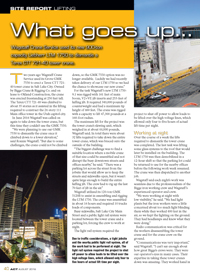 P.S. If your not quite through with this topic and would like to read another interesting, albeit non-Crane Tech article, on this subject check out Page 40 of the August 2016 edition of American Cranes & Transport article “What Goes Up…” on the dismantling of a Houston Tower Crane (registration required).