
 Let’s face it, rigging gear doesn’t have an unlimited life. A sling is not made to be used day after day, year after year without eventually showing signs of wear and fatigue. However, when rigging becomes damaged before the end of its expected life span, it can be used as an opportunity for improvement instead of just seeing it as another piece of gear that has to be replaced.
Looking Past the Obvious
Several weeks ago, we blogged about Removing and Destroying Rigging Gear from Service. What we failed to mention is that it should not be enough to just find a damaged sling or know a problem exists and just replace it. Instead a good rigging program will take a closer look and evaluate “Why?” Why is the rigging damaged? Why does a sling need to be replaced at 3-months and not 6 or 12? Why is the sling getting kinked? Why is this shackle or hook deformed? “Why?”
Usually we find that the problem is either an issue with training or performance–employees need a better understanding of how the gear is designed to be used or there is carelessness that causes the damage. Sometimes management needs insight to reinforce safe practices and then other times we find that the gear being used is simply not correct for the job. The following are real-life examples of how stopping to ask “Why” after identifying damaged rigging gear created a safer workplace.
Eyebolt Failure
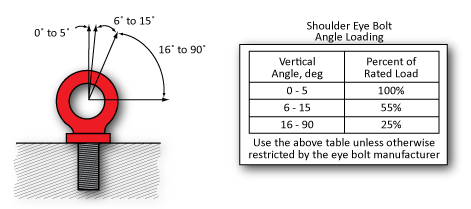
In one plant, riggers were using eye bolts on the top of a small motor to lift an entire mechanical assembly, resulting in a broken eye bolt and failed lift. Stopping to ask “why” identified the need for additional rigging training, as the weight of the assembly far exceeded the capacity of the eyebolt that was only intended to lift the shell of the motor. Additional instruction on various eyebolt thread patterns and capacity reductions when rigged at angles helped to ensure the next lift that used an eyebolt would have a better outcome.
Kinked Slings
Upon observing several kinked wire rope slings that did not pass inspection and were getting ready to be destroyed, the Crane Tech instructor asked how these slings were being used and what was being lifted. Upon closer examination, the slings were being used to lift from overhead beams, eventually becoming permanently deformed with many broken wires due to the sharp beam corners and an improper D/d ratio. 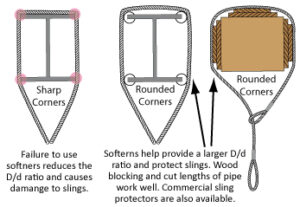 A simple addition of softeners on the beam corners could have reduced the probability of kinks forming and the slings having to be disposed of before the end of their natural life span.
However it was not enough to stop there. The larger concern was regarding the structural integrity of the building beam, to support a suspended load. If not specifically engineered to support a suspended load, then this could jeopardize the structural integrity of the building. Once Management learned that this type of lifting and rigging can not only damage a sling, but put their building at risk, they found a better way of lifting to get the job done safely.
Heat Damage
At the recommendation of their rigging supplier, a client was using a synthetic sling to pull pipe out of an autoclave at 310 degrees. The client did not realize that these slings had a maximum heat rating of 194 degrees. This situation was horrible and quite a big risk – had something gone terribly wrong the client would be liable because they were using the slings outside of the manufacturer’s parameters. Due to the heat damage, the client was constantly replacing slings, spending $5,000 a month in rigging. Needless to say stopping to ask “Why?” resulted in the client learning about the limitations of the gear and change in the type of slings purchased. The slings are now correct for the job and they do not need to be replaced as often—essentially creating cost savings while improving a culture of safety.
These are just a few instances, but there are many more, where a thoughtful approach and a little bit of education can result in positive changes across the work site. We cannot emphasize enough that properly inspecting and tracking the lifespan of rigging within your working environment can be beneficial. It’s not enough to buy gear because someone says it’s the right item and then using it till some one else says it isn’t or is damaged. Asking “Why?” can lead to discovering issues that once addressed can increase the life of equipment and allow for proper forecasting of when rigging gear will need to be replaced.
So we challenge you to stop and ask “Why?” next time you find damaged rigging gear. Take a closer look and see where improvements can be made so that every lift remains safe and you and your colleagues can return to home at the end of the day.
We want to hear from you! Comment below to tell your rigging stories.
Previous Crane Tech Posts on Rigging
- Are Your Riggers Qualified? – Blog Post on Construction Business Owner Magazine
- Removing and Destroying Rigging Gear from Service
- Can You Spot What’s Missing?
- It’s New, What Could Be Wrong?
- Bringing Rigging Concepts to Life – Rigging Spotlight in Crane Hotline